TLDR
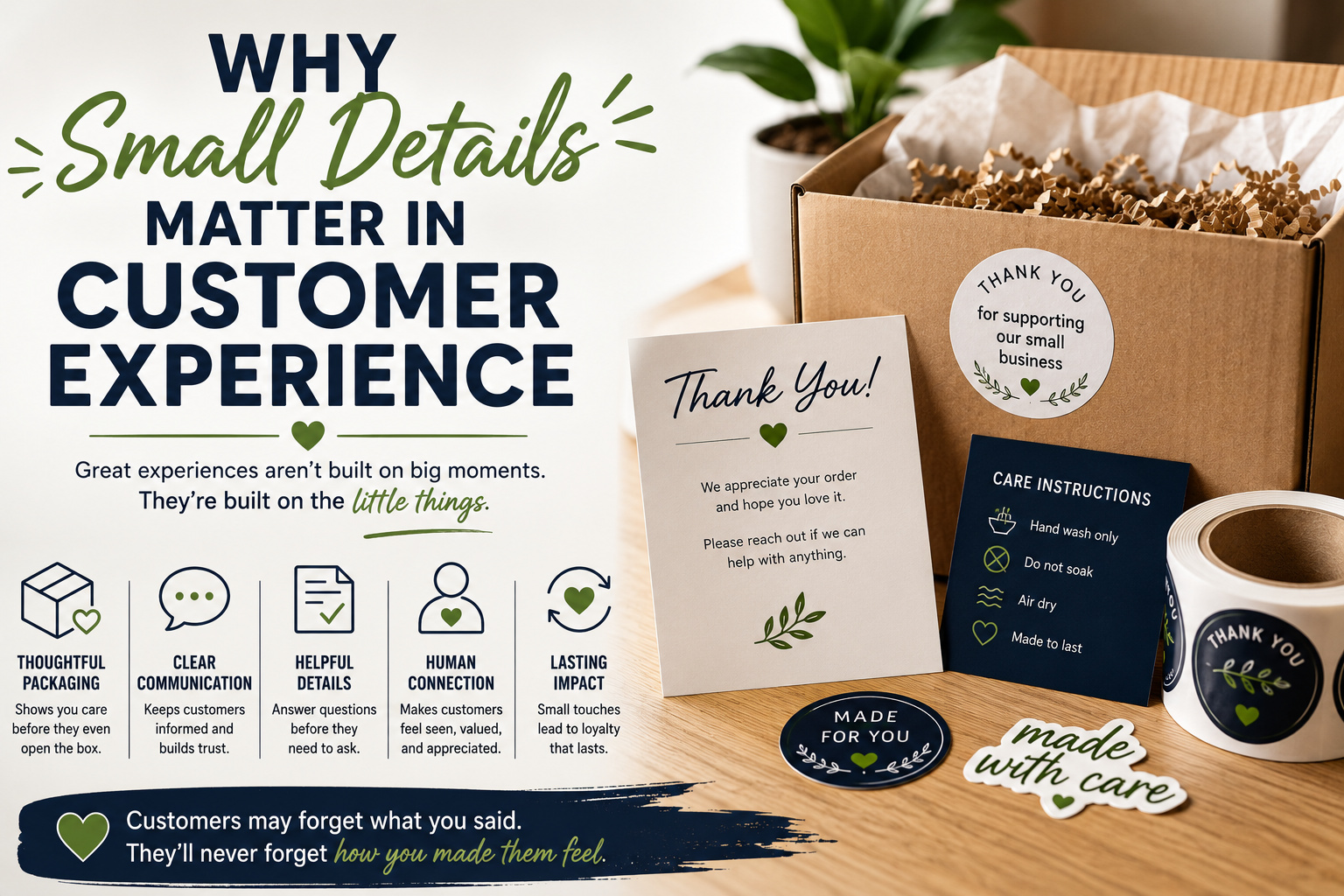
Customers judge a business through dozens of small interactions, not only the product they receive.
Clear order updates, accurate labels, thoughtful packaging, readable instructions, quick replies, and a simple thank-you message can make a business feel organized and dependable. Small mistakes can create the opposite impression.
The goal is not to add more decoration. It is to remove friction and show customers that someone considered what they would need next.
A major promise may persuade someone to place an order. Small details determine how they feel afterward.
The confirmation email arrives immediately. The product description matches what shows up. The package is easy to open. The care instructions answer the obvious question. And when the customer needs help, the response sounds like it came from a person who actually read the message.
That is why small details matter in customer experience. Each detail may seem minor on its own, but together they tell customers whether a business is reliable, attentive, and worth returning to.
Businesses do not always see those details the same way customers do. A 2024 PwC survey found that 90% of business executives believed customers highly trusted their companies, while only 30% of consumers said they did. That gap suggests businesses may overestimate how reassuring their processes feel from the outside.
Customer Experience Is the Full Sequence
Customer experience includes every interaction someone has with a business, from the first advertisement or search result to product use and post-purchase support. It is broader than customer service, which usually refers to direct help before or after a purchase.
A typical customer journey may include:
- Finding the business
- Visiting its website or store
- Comparing products
- Asking a question
- Placing an order
- Receiving confirmation
- Waiting for delivery
- Opening the package
- Using the product
- Requesting support or ordering again
A problem at any one of these stages can affect how the entire business is remembered.
That is why customer experience is rarely improved by one dramatic change. It is usually improved by reviewing the full sequence and fixing the small moments that create hesitation, confusion, or unnecessary work.
Why Small Details Matter in Customer Experience
Customers use small signals to decide whether a business is paying attention.
A spelling error on a product label does not automatically mean the product is bad. But it may make the customer wonder what else was overlooked. A delayed response does not prove the company is unreliable. But without an update, the customer has no other explanation.
Small details shape larger conclusions.
| Small Detail | What the Customer May Assume |
|---|---|
| Clear product descriptions | The business understands what it sells |
| Accurate order confirmation | The order was received correctly |
| Consistent branding | The company is established and organized |
| Secure packaging | The business cares about the product arriving safely |
| Easy-to-find instructions | The company understands how customers use the product |
| Fast, relevant support | A real person is available when needed |
| Honest delay notification | The business takes responsibility |
| Thoughtful thank-you message | The purchase is appreciated |
| Simple returns process | The company expects to treat customers fairly |
| Correct follow-up | The business remembers the customer’s situation |
Customers do not normally separate each item and score it. They form one overall impression.
Clear Information Prevents Doubt
Customers should not have to investigate basic details before buying.
Product pages should explain:
- What the product is
- What is included
- Available sizes and options
- How customization works
- Expected production time
- Shipping expectations
- Care or application instructions
- Return limitations
- How to get help
Clear information is especially important for custom products. A customer may need to understand how size is measured, where a cut line will appear, how colors may print, and when a proof must be approved.
Vague information shifts the work to the customer. They have to email, wait for a response, or place the order while hoping they understood correctly.
Good customer experience often begins by answering the next reasonable question before the customer has to ask it.
Confirmation Messages Should Confirm Something
An order confirmation should do more than say, “Thanks, we got it.”
It should help the customer verify that the order is correct.
Useful confirmation details include:
- Order number
- Product name
- Size
- Quantity
- Selected options
- Shipping address
- Estimated production or delivery timeline
- Proofing steps when applicable
- A clear way to report an error
The customer should be able to scan the message and notice a wrong address, quantity, or product selection quickly.
Do not bury important information below several large promotional banners. The customer just completed a purchase. The most useful next step is confirming what happens now.
Reliable Updates Reduce Customer Anxiety
Waiting feels longer when customers do not know what is happening.
A simple update can prevent unnecessary concern:
Your artwork proof is ready for review.
Your order has entered production.
Your package has shipped.
Your order is delayed by one business day. Here is the revised timeline.
The last message may not be enjoyable to send, but it is better than silence.
Customers are generally more accepting of a reasonable delay when they are told early and given a realistic new expectation. Avoid sending repeated updates that contain no useful information. Each message should explain what changed or what the customer should do next.
Consistency Makes the Business Feel Organized
Customers may encounter a business through social media, email, packaging, online ads, a marketplace listing, or a physical event.
Those interactions should feel connected.
Consistency includes:
- Business name
- Logo
- Colors
- Product terminology
- Support tone
- Pricing
- Policies
- Contact information
- Claims about quality and timing
Qualtrics describes a strong cross-channel experience as one with consistent branding and messaging, smooth movement between channels, and coordinated support.
A customer should not receive one answer through social media and a different answer by email. They should not see a product called “weatherproof” on one page and “water-resistant” on another unless the difference is explained.
Consistency makes the business easier to understand. And an easy-to-understand business usually feels safer to buy from.
Packaging Is Part of the Product Experience
Packaging has a practical job: deliver the correct product without damage.
But packaging also acts as physical evidence of how the business operates. Customers notice whether the box is clean, the product is protected, the label is accurate, and the contents are arranged with some care.
Good packaging does not need to be expensive. It needs to be appropriate.
A customer package may include:
- The correct product
- Protective material
- A packing slip
- Care or application instructions
- Contact information
- Return guidance
- A thank-you message
- One useful branded item
The package should also be easy to open without damaging the product.
Custom label and packaging stickers can add product information, care instructions, package seals, or consistent branding to plain boxes, bags, jars, and mailers. CustomStickers provides an online proof so businesses can review how the artwork will print and cut before production.
The goal is not to cover every surface with a logo. It is to make the order look deliberate and complete.
A Thank-You Message Adds Context
A short thank-you message can change the tone of a package.
Without one, the order may feel purely transactional. With one, the customer receives a simple acknowledgment that their purchase matters.
The message can be brief:
Thank you for your order. We appreciate your support and hope you enjoy your purchase. Please contact us if you need anything.
A note card can also include:
- Basic care instructions
- One useful tip
- Support information
- A reorder reminder
- A review request
- A discount for a future purchase
Keep it focused. A card asking the customer to follow five social accounts, join a rewards program, leave a review, refer three friends, and immediately buy again feels less like a thank-you and more like a task list.
Custom note cards can be printed with a logo, name, monogram, or simple design for thank-you messages and package inserts. CustomStickers prints them on sturdy 16-point paper in a 4-by-5.5-inch format.
Small Freebies Should Be Worth Keeping
A free sticker, sample, or small insert can make an order feel generous. But the item should have some connection to the product or customer.
A useful package freebie may be:
- A decorative sticker
- A small product sample
- A care accessory
- A replacement part
- A recipe or project card
- A small print
- A coupon for a related product
A branded sticker works best when it is a design someone would genuinely use. A large logo may appeal to loyal customers, but an illustration, mascot, or product-related phrase may have broader appeal.
Custom vinyl stickers are lightweight and can be printed in custom shapes for package freebies, product branding, events, and customer gifts. CustomStickers’ standard vinyl stickers include a protective laminate and are designed for indoor and outdoor use.
One good freebie is enough. Adding several unrelated promotional items can make the package feel cluttered.
Instructions Should Be Written for a First-Time Customer
Businesses become familiar with their own products. Customers do not have that advantage.
Instructions should account for what a first-time user may misunderstand.
Explain:
- How to install or apply the product
- What surface preparation is required
- How long to wait before use
- How to clean it
- What conditions to avoid
- How to store it
- What normal variation looks like
- When to contact support
Use plain language and short steps. Photographs or diagrams can help when orientation, assembly, or placement matters.
A QR code may lead to a longer video or online guide, but important safety and usage information should not exist only behind a link.
Personalization Works Best When It Is Useful
Customers often appreciate personalization when it makes an experience more relevant or convenient.
That might mean:
- Recommending accessories for the product they purchased
- Remembering a saved size
- Including the customer’s name on a note
- Sending care instructions for the exact item ordered
- Offering a timely reorder reminder
- Showing products related to previous purchases
But personalization can feel intrusive when a business uses more information than the customer expected it to have.
PwC’s 2025 customer experience research found that many customers see value in sharing information when it creates a smoother experience, but trust can fall sharply when that information is mishandled.
Use customer information to reduce work, not to show how much data has been collected.
Quick Responses Need to Be Relevant
Speed matters, but a fast answer that ignores the question is not good support.
Compare these responses:
We have received your message and will respond shortly.
And:
I reviewed the order. The blue line shows the outside edge of the sticker sheet, while the magenta lines show where each sticker will be cut. Your individual stickers will be cut as intended.
The second response solves the problem.
Good support should be:
- Prompt
- Specific
- Accurate
- Calm
- Easy to act on
- Consistent across channels
Qualtrics notes that customers value quick responses, but strong service also requires the team and systems needed to resolve the actual issue.
When more time is needed, tell the customer what is being checked and when they should expect another update.
Small Problems Need Clear Ownership
Mistakes happen. The response often matters more than the original problem.
A useful service-recovery response includes:
- Recognition of the issue
- A clear apology when appropriate
- Ownership of the next step
- A realistic resolution
- A follow-up after the issue is handled
For example:
I’m sorry the package arrived damaged. Please send a photo of the shipping box and product. We’ll review it today and arrange a replacement if needed.
Avoid making the customer contact several departments or repeat the entire explanation.
Qualtrics recommends using consistent recovery standards so customers with similar problems receive comparable treatment and outcomes.
A thoughtful resolution can preserve the relationship. A defensive or confusing response can turn a small production mistake into the part of the experience the customer remembers most.
Returns Should Not Feel Like a Trap
A business can have reasonable return limitations and still make the process clear.
Explain:
- Which products may be returned
- Whether custom products are excluded
- The return window
- Required condition
- Who pays return shipping
- How refunds are issued
- What happens with damaged or incorrect orders
- Where the customer begins
Do not hide important restrictions in a long policy that customers are unlikely to find before purchasing.
Clear policies help customers make an informed decision. They also give support staff a consistent process to follow.
Fix Repeated Questions at the Source
Customer questions are useful evidence.
If customers repeatedly ask the same question, the problem may not be that they failed to read. The information may be missing, hard to find, or unclear.
Track repeated questions about:
- Sizing
- Shipping
- Product compatibility
- Artwork requirements
- Installation
- Returns
- Materials
- Care
- Customization
- Order status
Then improve the page, email, proof, package insert, or label where the confusion begins.
Customer service should not only solve individual problems. It should help the rest of the business prevent those problems from recurring.
Measure the Details That Affect Real Behavior
Likes and social engagement can show that content is reaching people, but they do not fully describe customer loyalty.
Useful customer-experience signals include:
- Repeat purchase rate
- Return rate
- Complaint rate
- Resolution time
- Delivery problems
- Abandoned carts
- Proof revision reasons
- Customer questions
- Referrals
- Product reviews
- Support contacts per order
Qualtrics recommends evaluating loyalty through behavioral data such as repeat purchases, churn, referrals, complaint rates, and resolution times rather than relying only on social engagement.
The purpose is not to measure every interaction for the sake of having a dashboard. Track the points that reveal where customers are getting stuck.
A Small-Details Customer Experience Checklist
Review your customer journey and confirm that:
- Product descriptions answer basic questions.
- Pricing and shipping costs are clear.
- Order confirmations include correct details.
- Customers know what happens after ordering.
- Delays are communicated early.
- Branding and terminology are consistent.
- Support contact information is easy to find.
- Packages protect the product.
- Instructions are written for a first-time user.
- Thank-you messages are brief and genuine.
- Freebies are useful and relevant.
- Return policies are understandable.
- Problems have a clear owner.
- Repeated questions lead to process improvements.
- Follow-up messages have a useful purpose.
You do not need to redesign everything at once.
Choose the detail that currently causes the most questions, refunds, complaints, or manual work. Fix that first. Then move to the next point of friction.
Frequently Asked Questions
What Is Considered a Customer Experience Detail?
A customer experience detail is any small part of an interaction that affects how easy, clear, or pleasant it feels. Examples include button wording, confirmation emails, packaging, instructions, response times, labels, and return steps.
Do Small Details Really Affect Customer Loyalty?
Yes. Customers form an overall opinion from repeated interactions involving speed, convenience, quality, reliability, and consistency. Those factors influence whether they return or recommend the business.
Is Packaging Part of Customer Experience?
Yes. Packaging affects product protection, presentation, ease of opening, instructions, and the first physical interaction a customer has with an online order.
What Is the Easiest Customer Experience Improvement?
Clarify the question customers ask most often. Update the relevant product page, confirmation message, package insert, or policy so future customers do not need to ask.
Should Every Package Include a Thank-You Card?
It is not required, but a short thank-you note can make the order feel more personal and provide a natural place for care instructions or support information.
How Should a Business Respond to a Customer Complaint?
Acknowledge the specific issue, explain the next step, give a realistic timeline, and follow up after the resolution. Avoid forcing the customer to repeat the problem to several people.
Final Thoughts
Small customer experience details matter because customers use them to decide what kind of business they are dealing with.
A correct confirmation email suggests competence. A clear instruction card suggests preparation. Secure packaging suggests care. An honest delay update suggests accountability. A useful support response suggests that the business values the person, not only the transaction.
None of these details needs to be elaborate.
The strongest customer experience usually feels simple because the business did the complicated work behind the scenes. Information appears where it is needed. Problems have clear solutions. And each interaction supports the same message: this company pays attention.
That is how small details create a larger reason to return.